IPC Rackmount / Server Case
When Standard Won’t Fit: A Custom 1U Rackmount Chassis Built Around Your Hardware
Eight SSDs. Multiple custom boards. Full rack integration. Just 1U of vertical space. For a system integrator, the real challenge is not simply making everything fit—it is delivering a validated platform with reliable airflow, accessible I/O, serviceable components, and predictable rack installation. This project shows how a custom 600 mm-deep chassis solved those integration risks.
Off-the-shelf server cases work well until your hardware stops being standard. A connector sits in the wrong place. A heat sink needs more clearance. The drive bay blocks airflow. The rail position does not match the rack. Instead of redesigning the system around the enclosure, we design the custom 1U rackmount chassis around the system.
For this storage and network integration project, the client needed a compact 1U IPC chassis that could house non-standard electronics, eight 2.5-inch SSDs, a central fan array, rear I/O connections, and slide rails. The fixed limit was 600 mm in depth. Every millimeter had to earn its place.
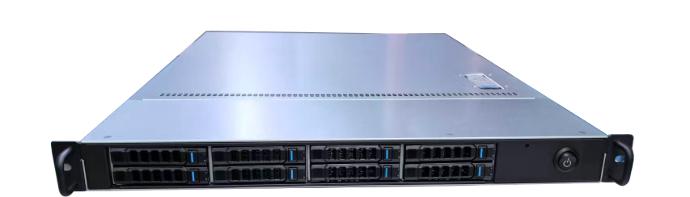
The
Challenge: Fit More Without Creating New Problems
The system combined a custom motherboard, dedicated power board, rear I/O board, eight-bay SSD module, and mid-mounted fan array within a tightly controlled 1U space. Making the parts fit was only the first test. The finished chassis also needed a clear front-to-rear airflow path, sufficient heat-sink clearance, accessible connectors, controlled cable routes, and enough working space for assembly and maintenance. Each bracket and mounting point had to support reliable installation without obstructing cooling or creating interference between components. Slide-rail positions, rear cable clearance, and rack compatibility also had to be verified so the complete platform could move smoothly from prototype assembly to system validation, deployment, and field service.
Start with the Hardware, Not an Empty Metal Box
A successful integration starts with a complete mechanical and thermal review of the entire platform—not only the chassis dimensions. We verify how the motherboard, power board, rear I/O board, SSD module, fans, cables, and slide rails interact within the available 1U space. This includes checking mounting points, component heights, heat sources, heat-sink positions, airflow restrictions, fan intake and exhaust paths, cable-bend space, connector access, and service clearances. Before prototyping, we also review board drawings, connector locations, keep-out zones, drive capacity, rack depth, rail travel, installation constraints, and expected production requirements. Potential conflicts are documented early, and practical changes to brackets, component positions, ventilation, or cable routes can be evaluated before metal is cut. The result is a clear chassis plan that supports prototype assembly, thermal and system validation, rack installation, maintenance, and production readiness while reducing avoidable revisions, delays, and integration risk.
The Breakthrough: Make Every Millimetre Work Harder
The original layout could not meet the 600 mm depth target, so we revamped the internal structure instead of compromising the client’s hardware configuration. We evaluated the position of each board, the eight-bay SSD module, the fan array, the rear I/O assembly, and the cable paths as one integrated system. A smaller fan bracket allowed the SSD tray and motherboard to move closer together while preserving a direct front-to-rear cooling path and sufficient intake space around the fans. We also developed a more compact rear I/O mount to recover additional depth without restricting connector access or cable-bend clearance. Bracket geometry and mounting points were adjusted to prevent component interference and retain practical access for assembly, inspection, and replacement. The revised layout did more than make the components fit: it created a cleaner, production-oriented platform that met the depth requirement while supporting thermal testing, system validation, rack installation, routine maintenance, and future integration work.
A Chassis Is Only Successful When It Works in the Rack
Installation details can turn a good mechanical drawing into a frustrating product once the system reaches the rack. We checked slide-rail travel, mounting positions, fixing-hole patterns, chassis balance, and rear clearance against the target installation environment. The rail geometry also had to allow the unit to extend smoothly for service without interfering with nearby equipment or putting unnecessary strain on connected cables. Because space behind the rack was limited, we refined the rear I/O bracket to improve connector visibility, finger access, cable-bend radius, and the ability to disconnect or replace individual cables without disturbing adjacent connections. We also considered how technicians would install, inspect, and service the system in the field, including access to fasteners and removable components. Verifying these details before production helps system integrators avoid unexpected rack conflicts, delayed deployments, difficult maintenance procedures, and costly mechanical changes after system validation.
What Can Be Customized for Your System?
· Custom motherboard, backplane, power-board, and I/O mounting
· 2.5-inch or 3.5-inch drive-bay configurations
· Optimized fan placement and airflow paths
· Front-panel cutouts, indicators, switches, ports, and branding
· Rear I/O openings and cable-clearance solutions
· Short-depth or application-specific chassis dimensions
· Slide-rail and rack-mounting compatibility
· Prototype refinement and production-oriented assembly design
Have a Difficult Layout? Let’s Turn It into a Buildable Chassis
If standard enclosures force you to compromise, share your board drawings, component list, target dimensions, thermal requirements, I/O map, rack details, expected quantity, and current project stage. We can review the mechanical interfaces, component clearances, airflow path, cable routing, rail compatibility, assembly sequence, and service access before the design moves into prototyping. By identifying potential conflicts early, we help system integrators reduce repeated hardware revisions and keep validation schedules on track. Whether you are developing a storage platform, network appliance, edge computing system, or industrial computer, we can support the project from initial layout review and custom bracket design through prototype refinement and production-ready documentation. The goal is a custom 1U rackmount chassis that not only fits the hardware, but also supports reliable cooling, efficient assembly, straightforward rack installation, system validation, and long-term field maintenance.